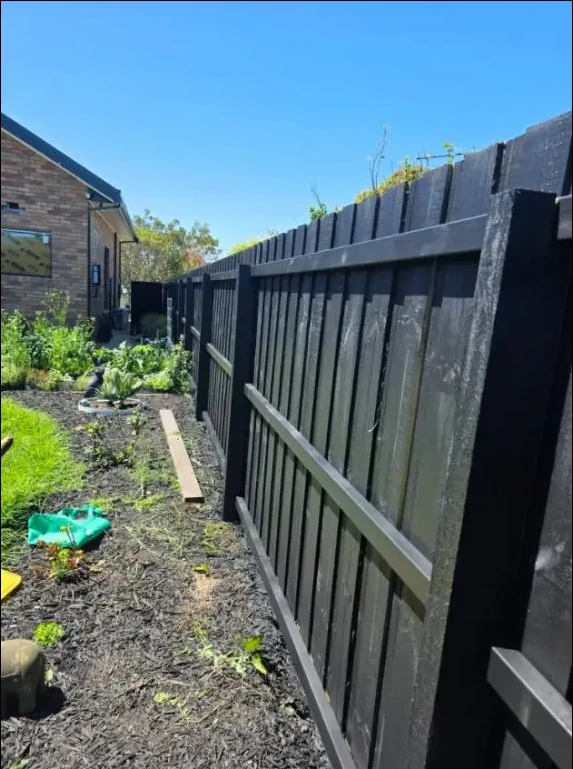
A tall timber paling fence now runs the length of this backyard in a near-black finish, framing the brick home and garden beds instead of competing with them.
Get a Free Fence Painting Quote
Project Summary
Painters of Geelong painted a tall timber paling fence in a dark charcoal finish at a single-storey brick home in Grovedale, Victoria. The fence runs alongside a landscaped garden bed, and the finish is carried consistently across the palings, rails and posts.
The Backyard
In many Grovedale backyards, the boundary fence is one of the biggest surfaces homeowners see every day. It runs behind the garden beds, borders the lawn and shapes how the outdoor area feels.
In this completed project, a deep charcoal finish creates a striking contrast with the home's warm brickwork and surrounding greenery. It shows how much visual impact a boundary fence can have, even when the garden is meant to be the focus of the backyard.
Paint or Replace?
A new fence is a big job and a big cost. If the timber is still solid, repainting is often the more practical way to refresh it: the structure stays, the boundary line stays, and the colour changes. Paint can't fix a failing fence, though, so it helps to know which side of the line yours sits on.
The Fence Painting Project
Learn about our professional fence painting services in Geelong.
Preparing and Painting
This is how we typically approach residential timber fence painting, from the first inspection to the final coat. The exact steps depend on each fence's timber, existing coating and surroundings.
A timber boundary fence can remain structurally sound even when its appearance starts to deteriorate. For a residential fence like this one, the first step is to examine the condition of the vertical palings, horizontal rails and support posts.
A typical assessment checks for loose boards, weathered timber, previous coatings, moisture damage and areas needing minor repairs. Where the timber is sound, professional repainting can be a practical alternative to replacing the entire fence.
Proper surface preparation is essential for a consistent, long-lasting exterior finish. Depending on the fence's condition, it may involve removing dirt and surface contamination, treating mould where necessary, scraping loose paint and sanding rough or uneven areas. Loose palings or minor timber defects should be addressed before coating begins.
For a fence beside landscaped garden beds, nearby plants, brickwork and paving also need protection from dust, paint splashes and overspray. These steps create a suitable surface for the new exterior coating.
The completed fence has a deep charcoal, near-black appearance that contrasts with the warm brickwork and greenery around the property. A solid charcoal finish can look more contemporary while visually unifying individual palings, rails and posts.
For a project like this, a high-quality exterior timber coating formulated for Australian outdoor conditions would be appropriate, subject to the timber and the manufacturer's instructions. The exact colour, product and sheen should be chosen after considering the existing timber, previous coatings and how exposed the fence is.
An even fence finish needs careful coverage across individual palings, their edges, the horizontal rails and the posts. Depending on access, the coating specification and how close surrounding surfaces are, painters may spray, brush, roll or combine methods.
A typical specification involves:
The number of coats and the application method always follow the product manufacturer's recommendations and the site conditions.
| Service | Residential timber fence painting |
|---|---|
| Fence type | Timber paling boundary fence |
| Surface preparation | Cleaning, scraping and sanding as required |
| Repairs | Minor timber repairs where required |
| Primer | Compatible exterior timber primer where required |
| Finish | Solid dark charcoal exterior coating |
| Application | Spray with brush detailing, if site access permits |
| Finishing coats | Two |
| Typical duration | 1–2 working days for a modest, accessible fence, depending on scope, drying conditions and preparation |
This is a typical specification for a charcoal timber fence repaint. The actual preparation, coating system and timing for any fence depend on its timber, existing finish and site conditions.
The Transformation
The fence reads as a solid, near-black backdrop running the length of the garden. Against the red-brown brick of the house and the fresh greens planted along the bed, the dark finish pulls the eye towards the garden rather than the boundary.
The construction stays easy to read, with vertical palings, horizontal rails and chunky posts, because the colour is even across every part. The timber's texture still shows through the finish rather than being flattened. The fence isn't trying to be the feature. It frames what's in front of it, and the house and garden keep their own character.
Why It Matters in Geelong
A fence is outside every day, taking sun, rain and wind, plus sprinkler spray and garden moisture down at the base. While its coating is intact, it helps protect the timber underneath. Once the finish breaks down, the timber is exposed, and the wear tends to speed up.
It's also one of the longest continuous surfaces on a property, which makes a boundary fence both one of the most exposed and one of the most visible. This project is in Grovedale, but the same questions apply across nearby suburbs, including Belmont, Highton and Waurn Ponds. For homeowners looking for painters in Grovedale, the first step is simply an on-site look at the fence.
Looking After It
Even a professionally applied exterior coating needs an occasional look. Check the fence now and then for peeling, cracking, moisture-related deterioration and damage to individual boards.
Keeping soil and vegetation from trapping moisture against the timber, cleaning the surface appropriately and dealing with coating wear early all help maintain the finish. How long it takes before a maintenance coat is needed depends on the timber, the coating system, how exposed the fence is and the manufacturer's recommendations.
Common Fence Painting Questions
Often, yes, as long as the fence is structurally sound: posts firm, rails secure and palings largely intact. If the timber is rotting, the fence leans or many palings are split or missing, repair or replacement usually needs to come first.
It depends on the look you want. Paint gives a solid, even colour and covers the grain. Stain lets more of the timber show through. The condition of the timber and any existing coating also affect the choice. For the staining option, see our deck and timber staining services.
There isn't a single price. Cost depends on the fence's length and height, how many faces need painting, the timber's condition, what's on it now, the preparation needed and how easy it is to access. The most reliable figure comes from a quote after someone has seen the fence.
Generally, yes, provided the surface is prepared and the coating suits what's already on the timber. Darker colours absorb more heat than light ones, so an exterior-grade coating matters.
There's no fixed figure. It depends on the timber, the preparation, the coating, how exposed the fence is and how well it's looked after. A well-prepared, well-coated fence generally holds up longer than a rushed one, and an occasional check helps you catch wear early.
Yes. Dirt, mould and loose or flaking paint should be dealt with so the new coating can bond properly. Skipping preparation is one of the most common reasons a fence finish fails early.
It can be done with care. Plants close to the fence are tied back or protected where practical, and the surrounding ground is covered. If you have delicate or established plants tight against the fence, mention them when you request a quote.
We carry out exterior painting in Grovedale and nearby Geelong suburbs, including Belmont, Highton and Waurn Ponds. If your suburb isn't listed, get in touch and we'll confirm whether we can help.
Related Geelong Painting Services
Want to see more finished work? Browse our painting project portfolio.
If your fence is structurally sound but looking weathered or outdated, repainting may be an option worth exploring. Painters of Geelong can assess the condition of your timber fence, discuss suitable colours and coatings, and recommend an appropriate preparation and painting approach.